
Search Minnesota Obituary Records
Minnesota obituary records and death records go back to 1870, when state law first required counties to track deaths. Whether you are searching for a family member's death certificate, looking for an old newspaper obituary, or doing genealogy research, Minnesota has multiple sources that can help. This guide covers the key agencies and databases for finding Minnesota obituary records, from the state Department of Health to local county offices to historical archives stretching back over 150 years.
Minnesota Obituary Records at a Glance
Where to Find Minnesota Obituary Records
Minnesota obituary records and death records are held by several agencies depending on the time period and what you need. The Minnesota Department of Health is the main state agency for death certificates from 1908 to the present. They issue certified and non-certified copies of death records for all 87 counties. For deaths from 1997 onward, any county vital records office in the state can pull the record from the statewide electronic system. For older deaths, you usually need to contact the county where the person died or the Minnesota Historical Society.
County vital records offices are one of the most direct routes to Minnesota death records. All 87 counties have offices that can issue death certificates. In many counties, records go back to 1870. The Minnesota Department of Health maintains a complete directory of all county vital records offices with addresses, phone numbers, and hours for each location. Fees are set statewide at $13 for a first certified copy and $6 for additional copies ordered at the same time.
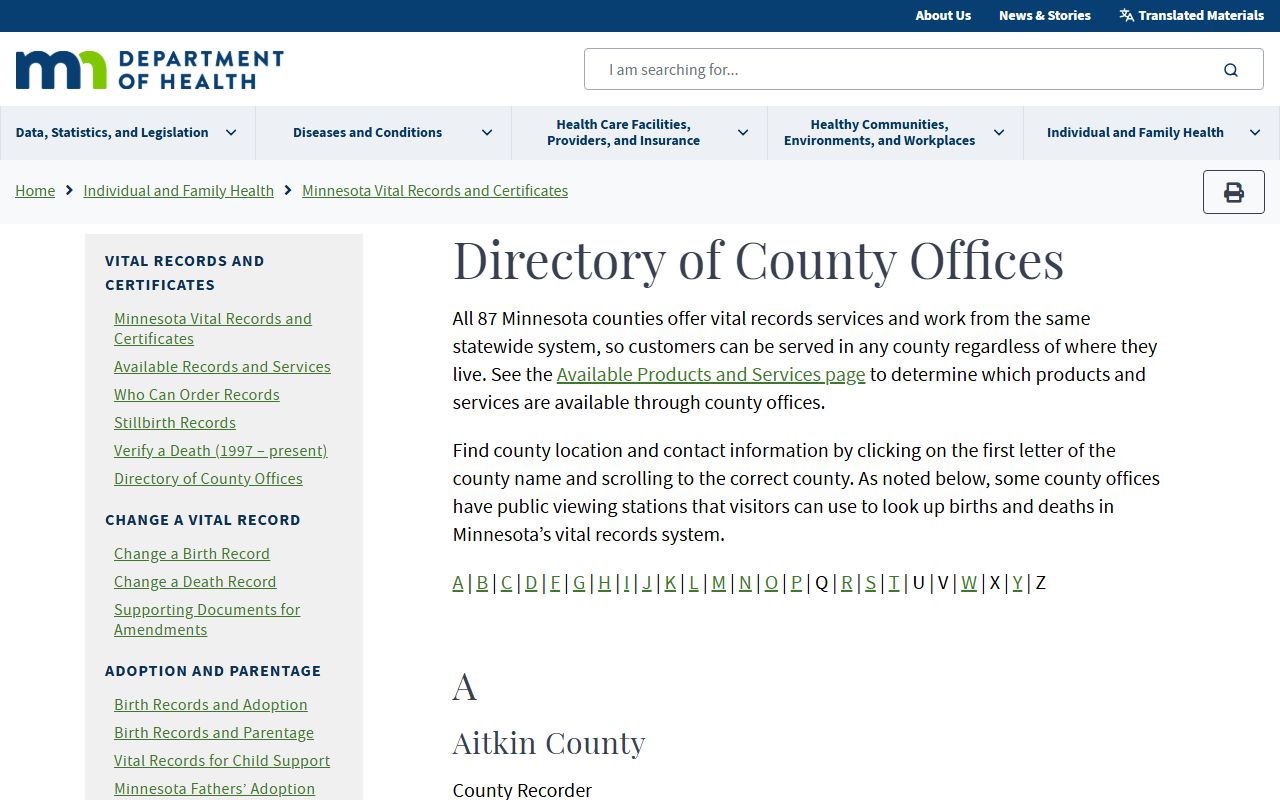
The MDH directory lists contact details for all 87 Minnesota county offices where you can request death certificates and obtain obituary-related vital records.
Note: Non-certified copies of Minnesota death records are available to the general public. You do not need to prove a family relationship to obtain a non-certified informational copy.
Minnesota Death Search Index
The Minnesota Department of Health runs a free online tool called the Death Search Index. It covers deaths registered in Minnesota from 1997 to the present. You can use it to confirm that a death occurred, get the state file number, and see the date of death. The search requires either a date of birth or a Social Security number for the person you are looking for. Results show the decedent's name, date of death, and state file number. It does not provide the full certificate, but it confirms the record exists and gives you what you need to order a copy.
The tool is free to use and open to anyone. Visit the MDH Death Search Index to look up a death record. Once you have the file number, you can order a certified or non-certified copy from the state or from the county where the death was registered. Processing times vary. As of early 2026, the state was processing orders received several weeks prior. For faster results, contact the county vital records office directly.
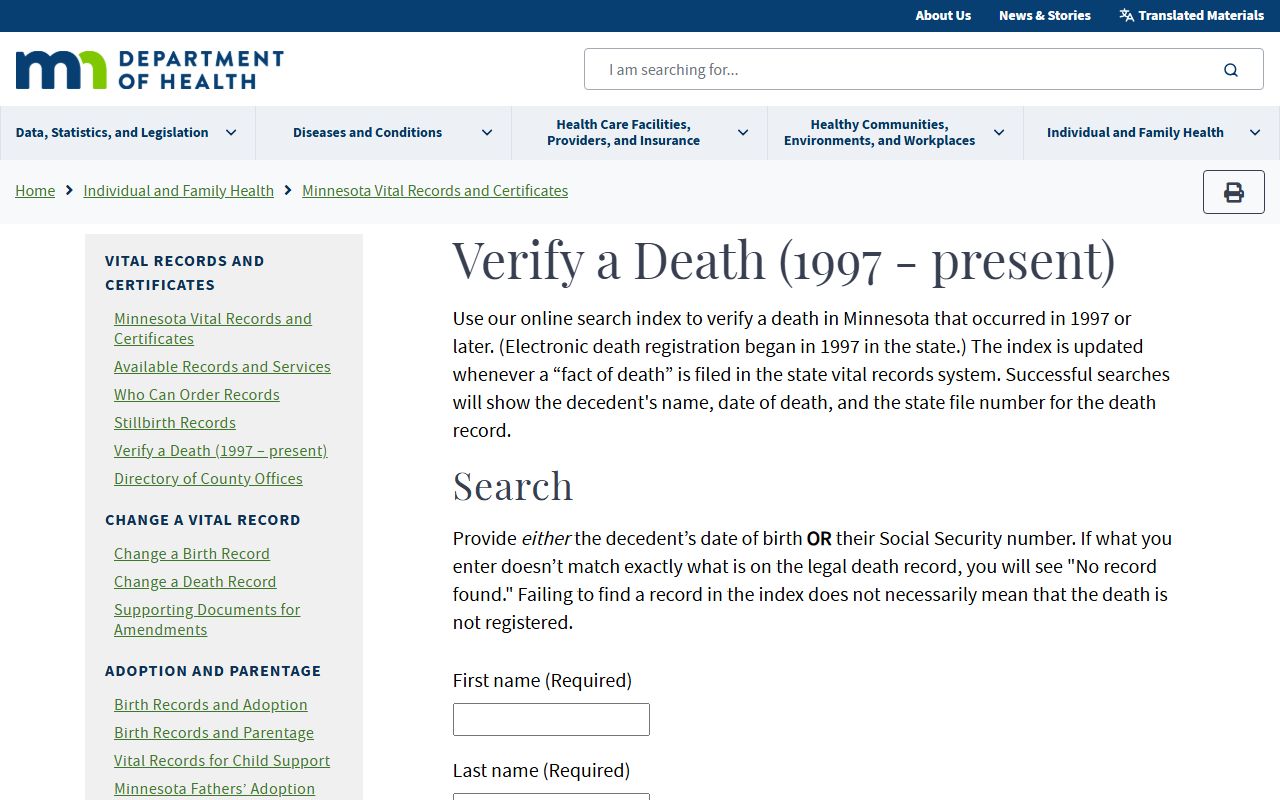
The MDH Death Search Index is the state's free public tool for verifying and locating death records from 1997 to present in Minnesota.
Historical Minnesota Death Records and Obituaries
Minnesota has a deep archive of historical death records reaching back before statewide registration began. County death registers exist as far back as 1870 in many parts of the state. Statewide death certificate registration did not start until 1908, so pre-1908 records require a county-level search or a visit to the Minnesota Historical Society. Between 1900 and 1907, the Department of Health compiled death cards from county sources. These are transcripts, not official certificates, but they are often the only statewide record available for that period.
The Minnesota Historical Society holds all of these historical records and has digitized much of the collection. Their online index through the Minnesota People Records Search covers deaths from 1908 through 2001. Records from 1904 to 1907 and from 1955 to 2001 include additional details like birthdate, birthplace, and mother's maiden name. For post-2001 deaths, the Department of Health holds those records and the MNHS does not. Non-certified copies from the MNHS cost $9 per record. Microfilm viewing at their library is free.
The MNHS Death Records Help page explains exactly what is in the online index and how to access records for different time periods.
The MNHS death records help page breaks down what is available in each time period and how to order copies of historical Minnesota death certificates and obituary records.
The MNHS Vital Records Research Guide at libguides.mnhs.org/vital/death is the most detailed resource covering the full historical timeline of Minnesota death record keeping, including Native American death certificates, probate records, and will books.
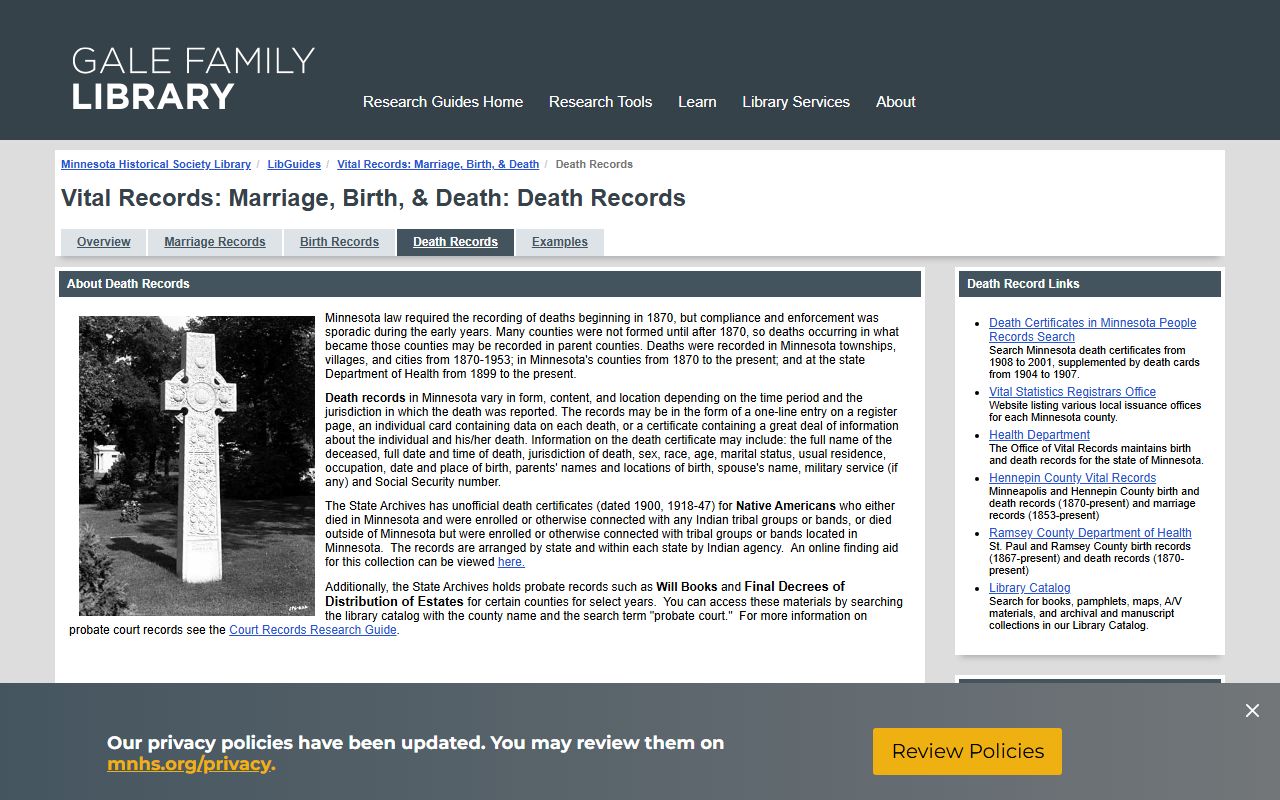
The MNHS vital records guide covers Minnesota death record history from the 1800s to the present, with research strategies for every era and record type.
Newspaper Obituaries Across Minnesota
Newspaper obituaries are among the most detailed and personal sources for death information. They often include family member names, towns of origin, cause of death, and details about a person's life that official death certificates do not capture. Minnesota newspapers go back to the 1840s, and many have been preserved and digitized for online access.
The Minnesota Historical Society runs the Minnesota Digital Newspaper Hub, which provides free access to millions of pages of Minnesota newspapers published before 1923. Key papers available online include the Minneapolis Tribune from 1867 to 1922 and the St. Paul Pioneer Press from 1861 to 1961. For newspapers published after 1923, you typically need to visit an MNHS library branch or use a subscription service like Newspapers.com or GenealogyBank. Many local libraries offer free access to these databases with a library card.

The Minnesota Digital Newspaper Hub gives free access to millions of pages of historical Minnesota newspapers, making it one of the best free tools for finding obituaries from the 1800s and early 1900s.
For recent obituaries, local papers are the go-to source. The Star Tribune covers the Minneapolis metro area. The Pioneer Press serves the St. Paul region. The Duluth News Tribune, Rochester Post-Bulletin, and St. Cloud Times cover their home areas. Most post-1990 obituaries from these papers can be searched on their websites or through Legacy.com, which aggregates death notices from papers across the country.
Iron Range Research Center
The Iron Range Research Center, part of the Minnesota Discovery Center in Chisholm, holds over 1.4 million genealogical records. This is one of the largest local genealogical databases in the state. Their obituary index covers northern Minnesota newspapers from 1891 through 2003. The search tool is free. If you find a record you want, copies are available for a fee. The center is especially valuable for researching families with roots in the mining communities of northeastern Minnesota.
Beyond obituaries, the center holds a naturalization index covering 1849 to 1985, a cemetery index from 1900 to 1999, and alien registration records from 1918. These companion records help place a death in context, confirm a person's identity, or trace immigration patterns. The center's website is at ironrangeresearchcenter.org. They also accept research requests for people who cannot visit in person.
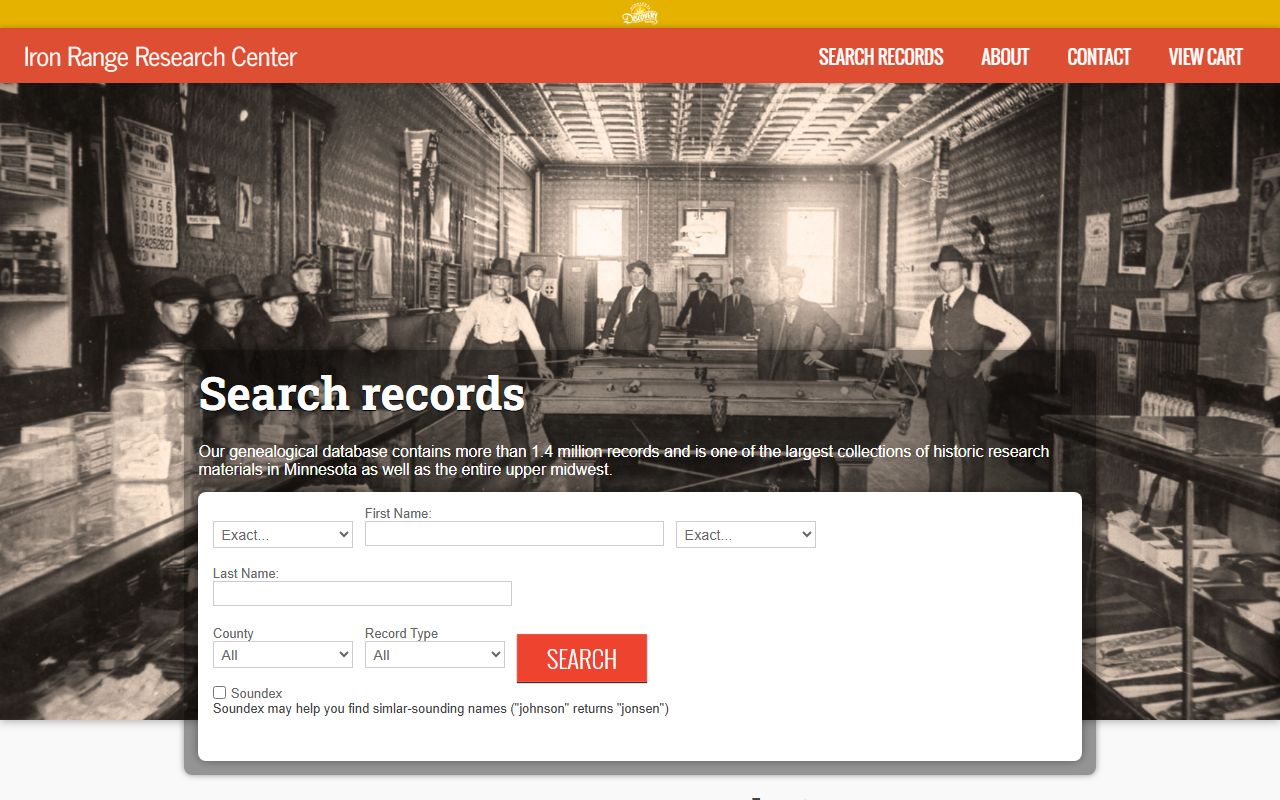
The Iron Range Research Center in Chisholm holds one of the largest regional obituary indexes in Minnesota, covering over a century of northern Minnesota death notices and genealogical records.
Requesting Obituaries and Death Records
The Minnesota Historical Society offers a fee-based research service for people who need help locating a specific obituary or newspaper article. You submit a request and MNHS staff search their newspaper archives and collections on your behalf. This is useful when you know the approximate date and location of a death but cannot access the newspaper archives yourself. The service covers obituary requests, general newspaper article requests, and historical "On This Day" requests. Details and fees are at the MNHS research services page.
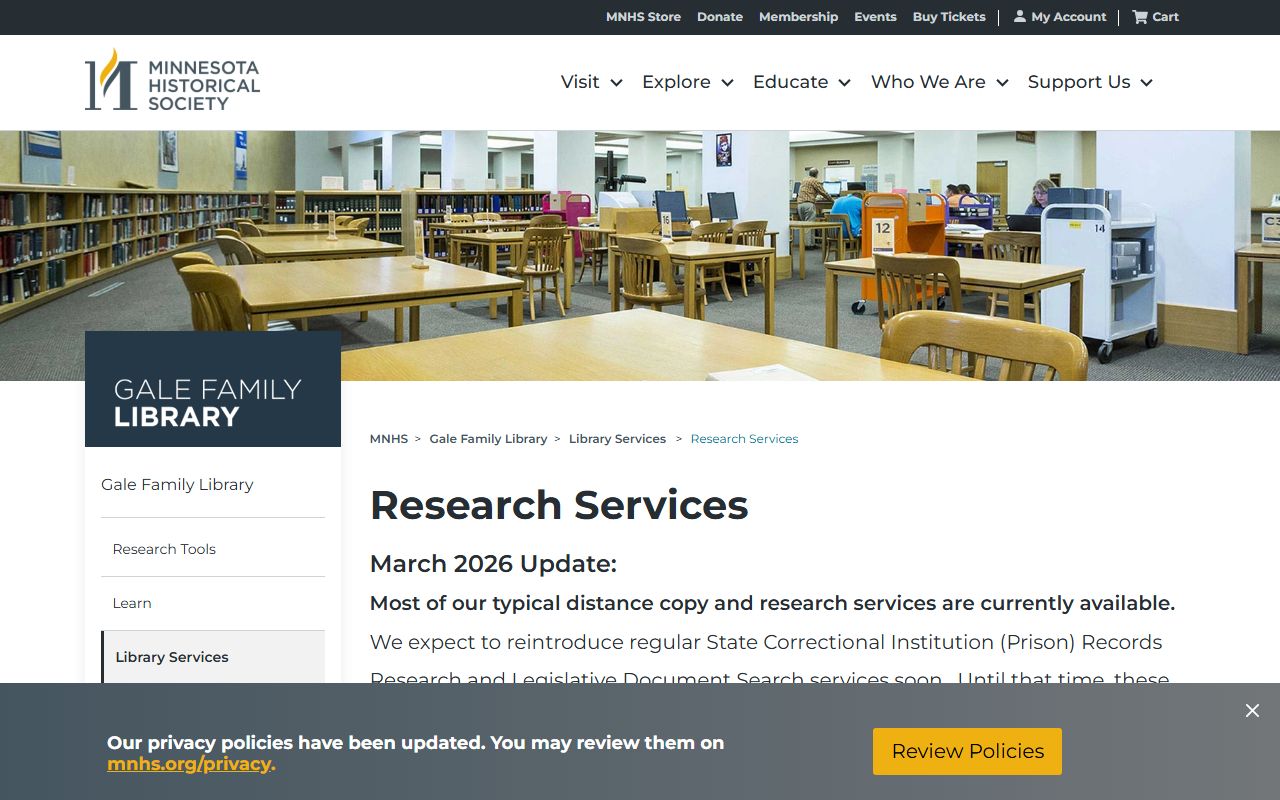
The MNHS research services page lets you submit requests for obituaries and newspaper clippings when you need expert help searching their historical collections.
For people who want to do their own research, the MNHS provides strong self-help tools. Their Research Self-Help page walks you through how to search for birth and death records, newspaper articles, obituaries, naturalization records, and more. FamilySearch also maintains several free Minnesota-specific collections, including the Minnesota Death Index 1908 to 2002, Minnesota County Deaths 1850 to 2001, and Minnesota Obituaries 1865 to 2006. These are at FamilySearch Minnesota Vital Records.
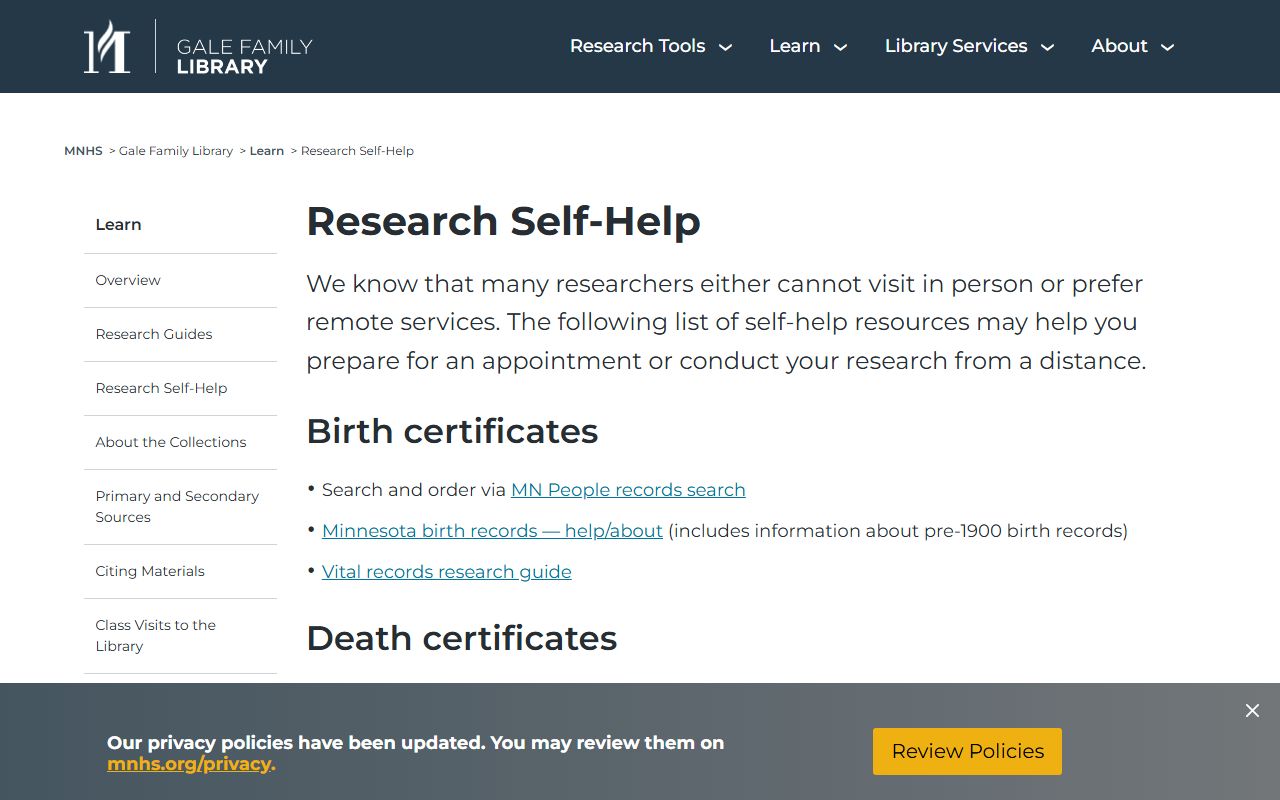
The MNHS self-help research page guides you through searching for obituaries, death records, newspapers, and genealogical records across all of Minnesota's historical collections.
Minnesota Death Record Access Laws
Minnesota death records are public records. Non-certified informational copies are available to anyone who requests them. You do not need to prove a family connection to receive a non-certified copy of a death certificate. Certified copies are restricted to people with a direct and tangible interest in the record. Under Minnesota Statutes section 144.225, certified records can be obtained by the spouse, children, parents, grandparents, grandchildren, and siblings of the deceased, as well as legal representatives, attorneys representing qualified individuals, and government agencies with a lawful purpose.
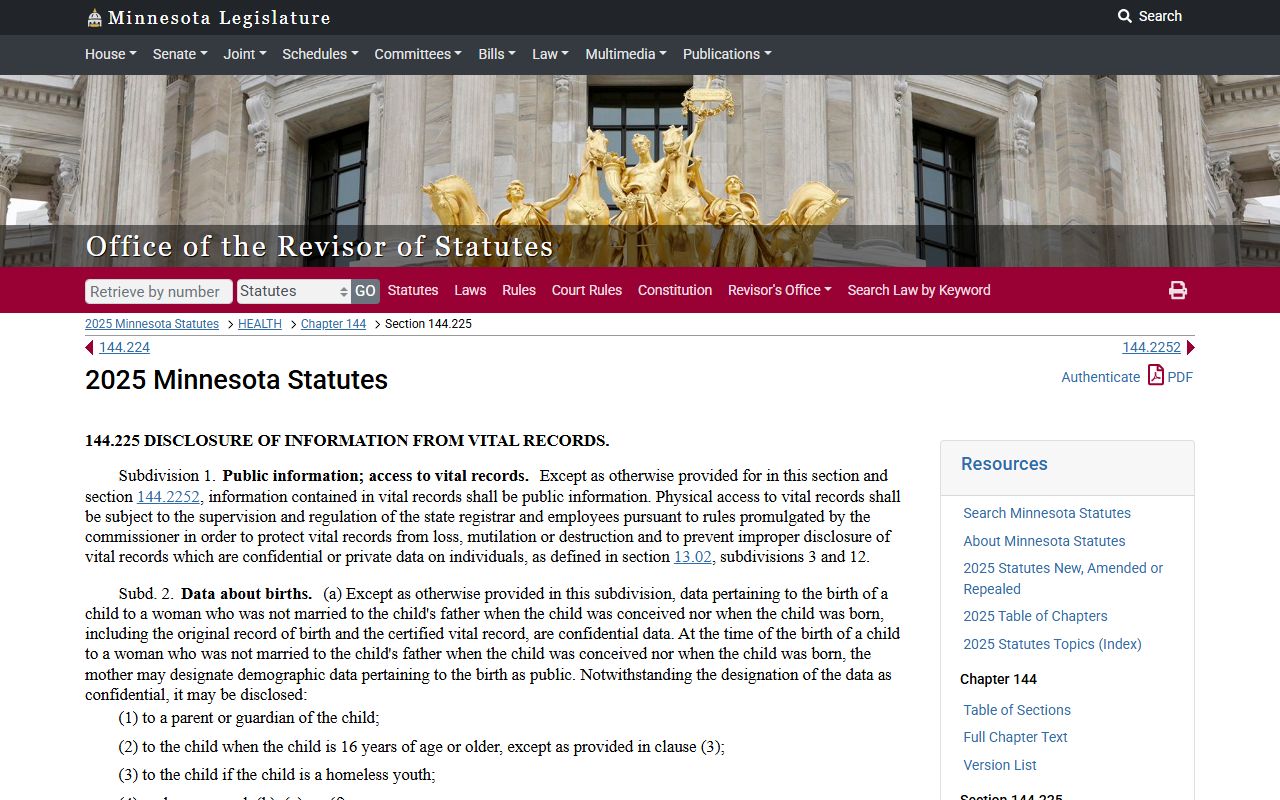
Minnesota Statute section 144.225 establishes who can obtain certified death records and sets the access rules that apply across all 87 Minnesota counties.
Fees are governed by section 144.226. The current fee is $13 for the first certified copy and $6 for each additional copy requested at the same time. The Minnesota Law Library offers a plain-language guide to obtaining death certificates at mn.gov/law-library. Administrative rules for how records are kept, amended, and issued are in Minnesota Rules Chapter 4601. These rules govern documentation standards, correction procedures, and certificate formats used by county offices throughout the state.
Minnesota required death registration beginning in 1870, though early compliance varied by county. The statewide electronic system launched in 1997 brought consistency across all counties and made records more accessible. For the full guide to obtaining Minnesota death certificates, visit health.state.mn.us.
Browse Minnesota Obituary Records by County
Each of Minnesota's 87 counties has its own vital records office that handles death certificates and related records. Select a county below to find local office details, contact information, and obituary resources for that area.
View All 87 Minnesota Counties
Minnesota Obituary Records in Major Cities
Major Minnesota cities handle obituary records and death certificates through their county vital records office. Select a city below to find out which county handles records in that area and where to search for obituaries locally.